The Ford 640: A Working Man's Tractor Built to Last
The Ford 640: A Working Man’s Tractor Built to Last
My dad’s tractor — a Ford 640, serial number 113417 — is one of the finest utility tractors Ford ever made. Painted blue, powered by the legendary 134 ci Red Tiger engine, and fitted with a live PTO and three-point hitch, it spent decades doing real work on real ground. This is the story of how that machine came to be, what makes it special, and why, more than 70 years later, parts are still plentiful and these tractors are still working.
The Road to the 640: A Short History of Ford Tractors
To understand the 640, you have to start in 1938 — in a Dearborn, Michigan field where Henry Ford Sr. shook hands with an Irish inventor named Harry Ferguson.
Ferguson had spent years perfecting a revolutionary idea: a hydraulic three-point hitch that attached implements directly to the tractor and used draft control to automatically adjust their depth based on soil resistance. It prevented the tractor from bogging down, eliminated dangerous rearing, and made a single operator far more capable than before. Ford was convinced in a single afternoon.
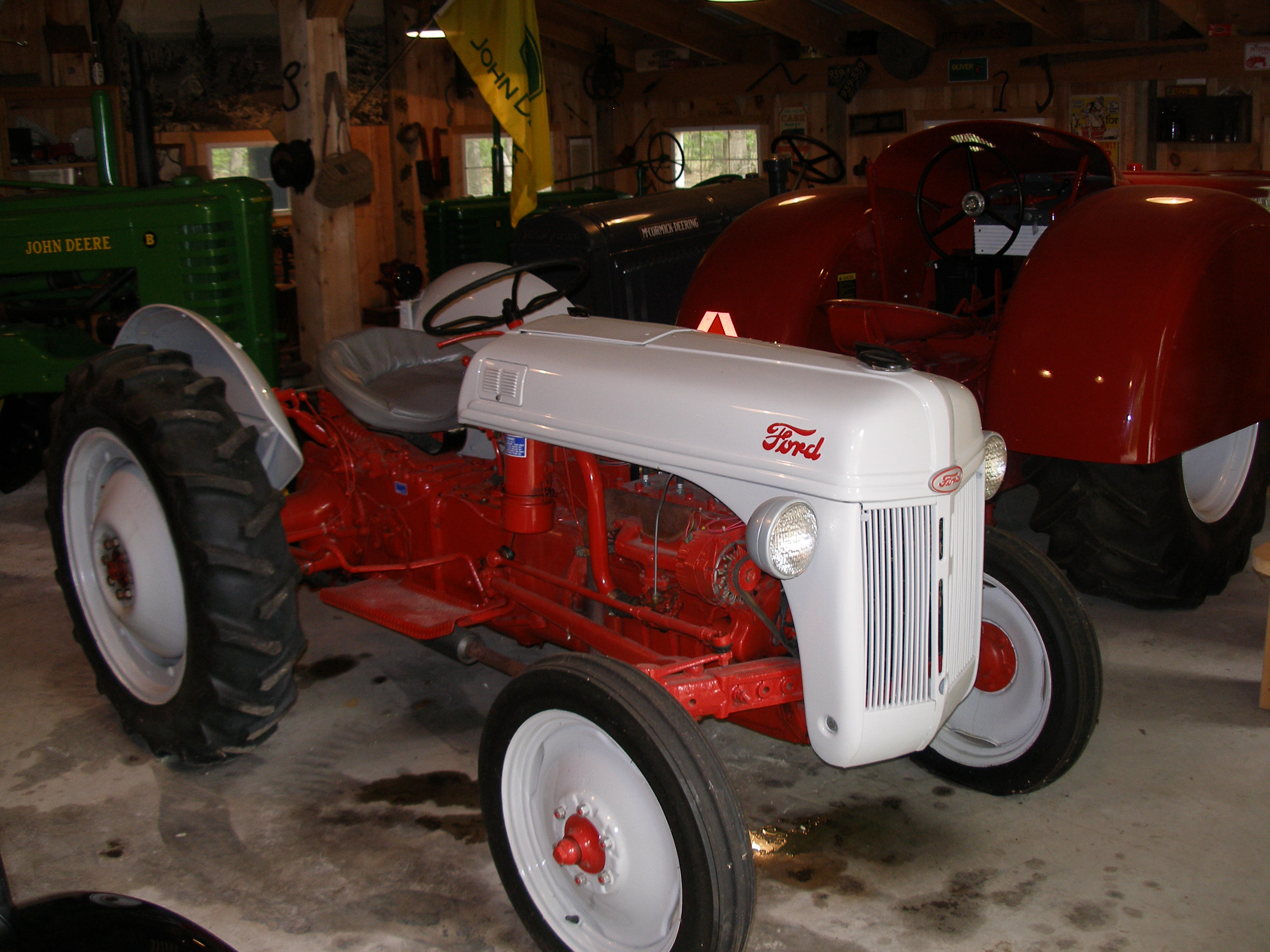
The result was the Ford 9N, introduced June 29, 1939 — America’s first mass-production tractor with a fully integrated three-point hitch. It sold for $585 fully equipped, roughly half the price of comparable machines. Nearly 100,000 were built before World War II interrupted production. The wartime Ford 2N followed (with rubber tires and starters rationed away), and then in 1947, Henry Ford II launched the Ford 8N — the red-and-gray tractor that became, by most measures, the most popular farm tractor in North American history. Over 524,000 were built.
But the handshake deal with Ferguson was fraying. Ford II ended it unilaterally when he launched the 8N. Ferguson sued in 1948 for $310 million in patent infringement. The case settled in 1952 for $9.25 million — and as part of the settlement, Ford agreed to redesign its hydraulic system. That redesign produced what came next.
The Ford NAA “Golden Jubilee” arrived in 1953, named to celebrate Ford Motor Company’s 50th anniversary. It was the first truly clean-sheet Ford tractor: a brand-new overhead-valve 134 ci engine (called the Red Tiger), live hydraulics independent of the clutch, and a refined three-point hitch no longer encumbered by Ferguson’s patents. It was larger, heavier, and more capable than the 8N. The tractor community took notice.
Then, in late 1954, Ford replaced the NAA with the Hundred Series — the 600, 700, 800, and 900 families. The 640 was born.
The Ford 640: What the Numbers Mean
Ford’s model numbering on the Hundred Series was a code, not just a name:
-
6 = 600 series (134 ci Red Tiger engine; the 800/900 used the larger 172 ci)
-
4 = 4-speed transmission with PTO and three-point hitch
-
0 = Hundred Series designation
So the 640 was the sweet spot of the 600 line: the full-featured workhorse. You got the proven Red Tiger engine, a four-speed gearbox, a Category I three-point hitch with 1,250 lbs of lift, and PTO — everything a two-plow utility tractor needed.
The 640 was produced from 1954 through 1957 at Ford’s Highland Park, Michigan plant. Original price in 1957 was $2,056. Ford sold them by the tens of thousands to farms across America.
The 134 ci Red Tiger Engine
The heart of the 640 is the Ford EAE Red Tiger — a 134 cubic inch, four-cylinder overhead-valve engine that was, in 1953, a genuine technological leap forward for Ford tractors.
The old 9N/2N/8N had used a side-valve (flathead) engine. Overhead valves breathe better, burn fuel more efficiently, and make more power from the same displacement. The Red Tiger delivered:
| Spec | Value |
|---|---|
| Displacement | 134 ci (2.2 L) |
| Bore × Stroke | 3.44" × 3.60" |
| Rated RPM | 2,200 RPM |
| Compression ratio | 6.6:1 |
| PTO horsepower (tested) | 31.01 HP |
| Drawbar horsepower (tested) | 28.59 HP |
| Firing order | 1-2-4-3 |
| Fuel | Gasoline (LP gas optional) |
| Coolant capacity | 15 quarts |
The Red Tiger was painted red — hence the name — and it proved so durable that Ford used variants of the same fundamental engine architecture through the 601/801 Workmaster series and into the early four-cylinder 2000 series. Bore and stroke dimensions were kept consistent across variants; Ford simply changed the bore to achieve different displacements (144 ci diesel, 172 ci gas and diesel) while keeping the same block. That lineage is part of why Red Tiger parts remain so available today.
For full specs, TractorData.com’s Ford 640 page is the go-to reference.
The Three-Point Hitch: Ferguson’s Revolution
The three-point hitch on the 640 traces its ancestry directly to Harry Ferguson’s 1926 British patent. The geometry — two lower link arms plus one top link, attached hydraulically with draft sensing — is the same system that is today the global standard on virtually every tractor built (ISO 730). If you’ve ever used a tractor implement in the last 80 years, you’ve used a descendant of what Ferguson demonstrated to Henry Ford in that Dearborn field.
The 640’s Category I hitch has a lift capacity of 1,250 lbs and operates at 2,000 psi with a 4.8 GPM pump. The hydraulic system holds 2.25 gallons of fluid. The draft control — Ford’s redesigned version freed from Ferguson’s patents — automatically adjusts implement depth to keep engine load consistent. It’s elegant engineering that required no electronics to work.
The Wikipedia article on three-point hitches covers the full history if you want to go deeper. The Henry Ford Museum’s digital collection holds documentation of the original 9N prototype.
Live PTO: What It Is and Why It Matters
The 640’s live PTO was a significant improvement over the transmission-driven PTOs on the 8N and earlier tractors. On those older machines, the PTO shaft was mechanically tied to the drivetrain — when you pushed in the clutch to stop the tractor, the PTO stopped too. Implements like balers and rotary mowers store tremendous rotational energy, and when the clutch released that stored energy, it could feed back into the drivetrain and surge the tractor forward unpredictably.
With live PTO, the shaft keeps turning regardless of whether the main clutch is engaged. You can stop tractor motion without stopping the implement — a real safety and operational improvement for anyone running PTO-driven equipment. At 540 RPM, the 640’s PTO matches virtually every implement you’d want to run with a tractor of this size.
Serial Number 113417: What It Tells Us
The serial number on the 640 is stamped into the flat area of the transmission housing, on the left side above and behind the starter. Ford used a sequential numbering system across the entire Hundred Series — all 600, 700, 800, and 900 models shared the same sequence. The model designation (640) is stamped first; directly below it is the serial number, flanked by diamond stamps (◇113417◇).
The production ranges for the 600 series:
| Production Year | Serial Number Range |
|---|---|
| 1954 | 1 – 10,614 |
| 1955 | 10,615 – 77,270 |
| 1956 | 77,271 – 116,326 |
| 1957 | 116,327 – 144,015 |
Serial number 113417 falls in the 1956 production range (77,271–116,326), near the upper end. This tractor was built late in the 1956 production run, very close to the 1957 boundary. A tractor built at this point in the calendar year would typically have been sold as a 1956 or 1957 model year machine — which aligns with the 1955 model year designation that can appear on Ford title documents (Ford’s model year and production year sometimes differ for tractors sold near year-end changeover).
To look up or register your serial number:
The Color Story: Why It’s Blue
A factory 1955–1956 Ford 640 came in two colors: Vermilion Red on all the cast iron (engine block, transmission housing, rear axle) and Tractor Gray on the sheet metal (hood, fenders) and wheels. That classic red-and-gray scheme ran from the 8N through the entire Hundred Series.
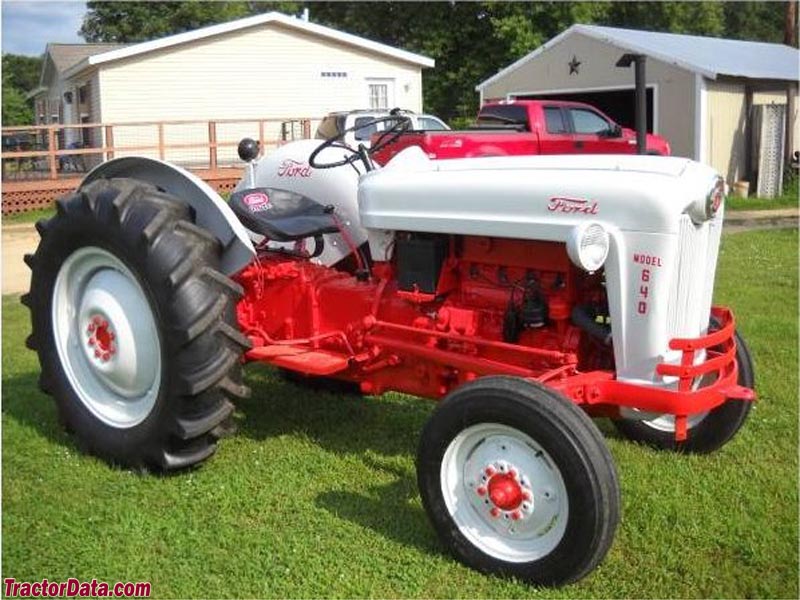
My dad’s 640 is blue. That happened because of what Ford did in 1962.
When Ford introduced the Thousand Series tractors (the 2000, 4000, and 6000) beginning in the 1962 model year, they retired the red-and-gray scheme entirely and switched to a rich Highland Blue paired with light gray. It was a deliberate modernization — the blue unified Ford’s agricultural and industrial equipment lines and gave the brand a sharper identity on the showroom floor.
| Color | Ford Code | Ditzler/PPG | Notes |
|---|---|---|---|
| Vermilion Red (original cast iron) | M1722 | 70205 | 8N through Hundred Series, 1948–1957 |
| Tractor Gray (original sheet metal) | M1750 | 30448 | 8N through Hundred Series, 1948–1957 |
| Highland Blue (1962) | MX700718 | 12720 | First model year of the blue era |
| Tractor Blue (1963–1965) | M20J1639A / WT8050 | 12809 | Most common “Ford blue” |
When Ford switched to blue, some dealers offered a discounted repaint program for owners of older red-and-gray tractors — the idea being to make the existing fleet look current and keep brand identity consistent in the field. It was a sales and marketing move: a farmer pulling up to town in a freshly repainted blue tractor looked like he was running a current machine. Some owners took advantage of it when trading or selling. A lot of surviving 600-series tractors in blue today got their color that way — not from the factory, but from a dealer’s paint booth.
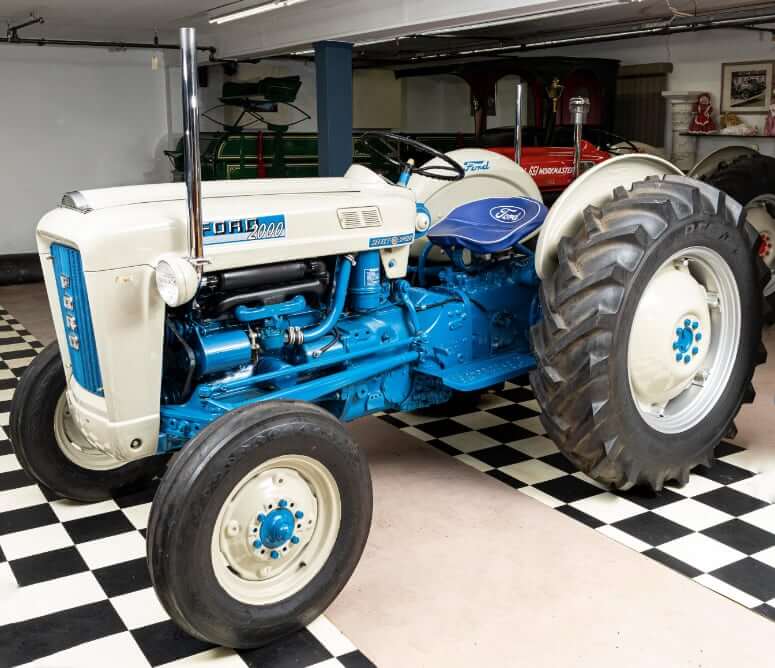
That’s almost certainly how dad’s 640 got its blue. If you’re restoring one to factory original, the correct colors are Vermilion Red cast iron and Tractor Gray sheet metal. If you want the blue, Ford code M20J1639A (Ditzler 12809) is the shade that came in on the 1963–1965 machines and is the one most people associate with “Ford tractor blue.”
Paint resources:
Built Tough, Easy to Maintain, Parts Are Plentiful
This is the thing about the 640 that keeps making it relevant: it was designed to be fixed in a farm shop with basic tools, and 70 years later, every part you need to restore or maintain one is still being made.
The Red Tiger engine runs on points ignition, a simple carburetor, and a mechanical fuel pump. There are no computers, no emissions systems, and no proprietary sensors. A farmer in 1957 could diagnose and fix anything on this tractor, and a farmer in 2026 can too. The 6-volt positive-ground electrical system is the only quirk that catches people — if you’re wiring accessories or using a modern battery, pay attention to polarity.
With basic care — or a proper restoration — a 640 will outlast most modern machines. There are 640s working fields today that have never had an engine rebuild. The cast iron is thick, the engineering is conservative, and nothing on this tractor was designed to be disposable.
Parts vendors:
-
Yesterday’s Tractors — large catalog, and the forums are invaluable for diagnosis
-
Steiner Tractor Parts — new restoration-quality parts for antique Fords
-
All States Ag Parts — new and used
-
Jensales — manuals, parts, and specs; their Ford 640 service manual covers the full 1954–1957 series
-
Stevens Tractor — 600 series parts
Manuals:
The Community
The Ford tractor community is active, knowledgeable, and genuinely helpful. If you have a question about a 640, someone on these forums has already answered it twice.
-
Ford Fordson Collectors Association (FFCA) — non-profit founded 1992; maintains a serial number registry, hosts an annual show, and publishes a newsletter. You can register your tractor by serial number .
-
N Tractor Club — covers the 9N through the 600/700/800/900 series; comprehensive serial number registry and technical resources
-
Yesterday’s Tractors Forums — the most active online community for vintage tractor owners; the Ford 600 series board has thousands of threads
-
TractorData.com — the definitive spec reference
Find One at a Show
If you want to see a well-restored 640 or Golden Jubilee in person, the Ford Fordson Collectors Association annual show draws hundreds of machines. The Smithsonian National Museum of American History holds agricultural equipment from this era, and the Henry Ford Museum in Dearborn, Michigan has the original 9N prototype and extensive Ford tractor history.

Unfortunately, this is what dad’s tractor looks like today, but we plan on a restoration project and bring it back to life. I’m collecting parts now.
The 640 wasn’t the flashiest tractor Ford ever made. It wasn’t the most powerful or the most expensive. But it was honest: designed to do work, designed to last, and designed to be fixed by the person who owned it. Seventy years later, that’s still worth something.