At Gilmore: The First Model A and a Campus Full of American Cars
At Gilmore: The First Model A and a Campus Full of American Cars
I spent August 4 at the Gilmore Car Museum in Hickory Corners, Michigan. The campus is 90 acres of barns, recreated dealerships, and partner museums, with more than 400 cars on the property. I came for the early American stuff, and I ended up in the Model A Ford Museum longer than I meant to.
That building is a story of its own. It opened in 2014 as a recreation of a 1928 Ford dealership, put up by the Model A Ford Foundation on Gilmore’s land. It is the largest public museum dedicated to the Model A. If you have read my posts about the car companies that came and went before Ford locked the industry down, this is the other side of that story: the car that replaced the Model T, and the first one ever built is sitting on the floor.
Edison’s Phaeton
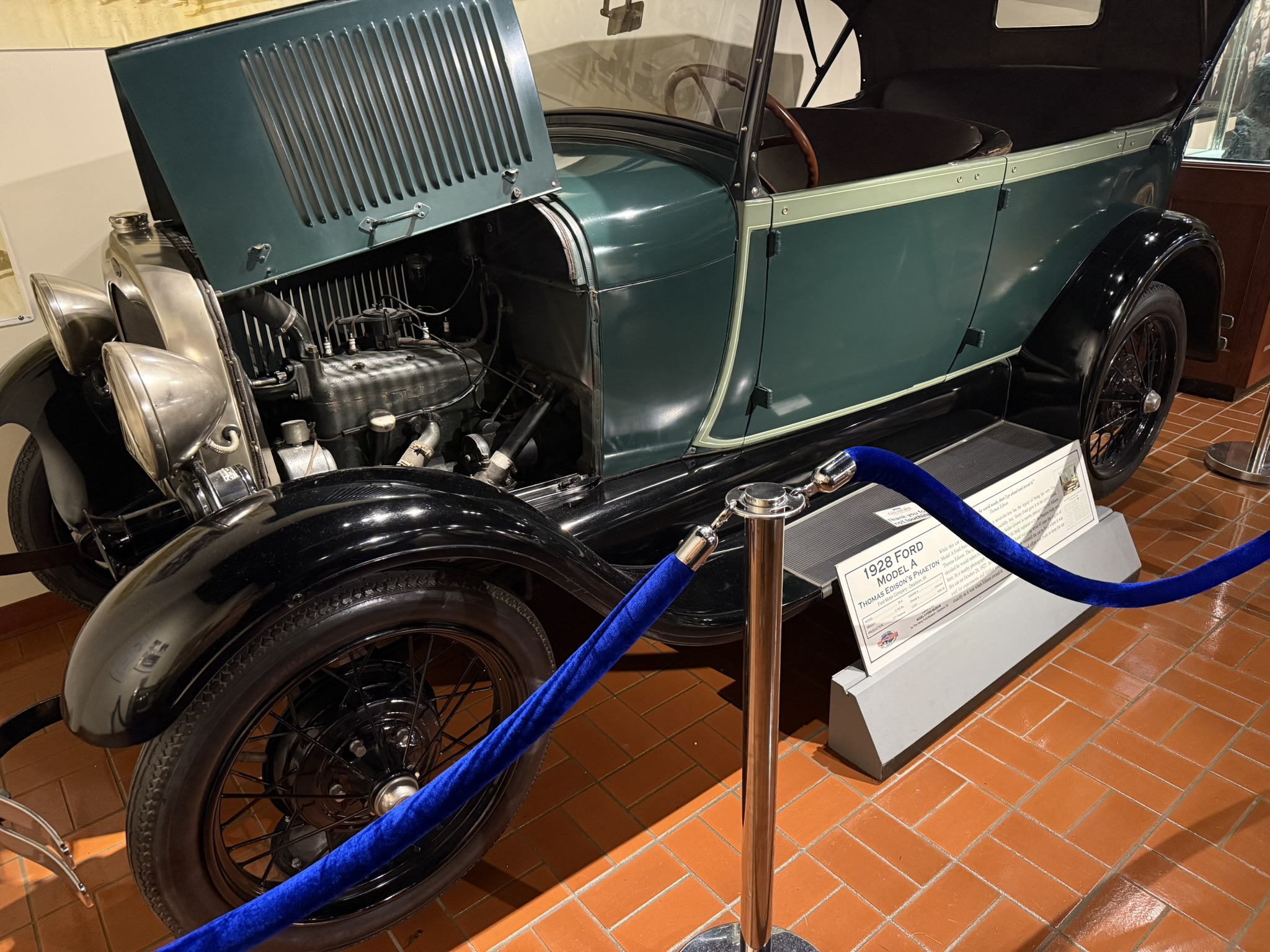
The two-tone green phaeton with the hood open is the first Ford Model A. Engine serial number 1. Henry Ford gave it to Thomas Edison.
Ford had been chief engineer at the Edison Illuminating Company in Detroit. The two men stayed close for the rest of Edison’s life. When Ford finally replaced the Model T, after 19 years and a factory teardown that still ranks among the most expensive changeovers in American manufacturing, he sent the first new car to his friend. It started as a Tudor sedan. Edison preferred open cars, so Ford had it rebuilt as a touring body. Edison drove it until he died in 1931. His widow, Mina, later returned it to Ford Motor Company.
The Model A was unveiled in December 1927. About 25 million people saw it in the first week. It had four-wheel brakes, hydraulic shocks, a sliding-gear transmission, and safety glass in the windshield. Prices ran from $385 for a roadster to $1,400 for a Town Car. In four model years Ford built nearly five million of them.
Six Bodies, One Chassis

A sign in the gallery puts the idea plainly: six body styles for open-air driving, all on the same car. Truck body. Four-door phaeton. Two-passenger roadster with a rumble seat. Two-door cabriolet with roll-up windows. Two-door phaeton. Convertible sedan with fixed door frames.
That is the Model A in one frame. Ford did not invent the idea of one chassis and many bodies, but he industrialized it at a scale nobody else could match. The museum lines them up the way a 1928 showroom would have: green phaeton, blue roadster, a wooden delivery in the back, a red-and-white biplane hanging from the ceiling. The airplane is a reminder that Ford was thinking about more than passenger cars in those years.
A Working Car in a Hard Decade

Around the corner the museum stops being a showroom. A black Tudor sits in sand, Kansas plate 73-605 from 1933, red wire wheels, the door open. There is an Idaho potatoes sack on the hood, a bean-company bag on the door handle, a washboard against the fender, a milk can in the dirt. The wall behind it is that decade: families, a loaded car, a dust storm coming in.
The Model A was four years out of production by then, and it was already the car a lot of people still had. Cheap to buy used, parts everywhere, simple enough to keep running on a farm or on the road west. I have written about the companies that tried to build automobiles before Ford finished consolidating the industry. This exhibit is what that consolidation looked like from the other direction. When times got bad, the car that survived was the one a family could still afford to own.
American Sweetheart

The 1931 roadster with the white scrollwork is not a factory body. The plaque calls it a Wrought Iron Roadster, handcrafted by blacksmith Owen Weddle. The hood, doors, and rear quarters are open filigree instead of sheet steel. “American Sweetheart” is worked into the iron, along with “THE MODEL A” and the Ford oval. Black fenders, cream wire wheels, tan top.
It is a one-off, and it belongs in this building anyway. The Model A invited this kind of work. The chassis was cheap and everywhere, the engine was honest, and people who could make things with their hands treated it as a starting point. Weddle started with a hammer and a forge instead of a body shop.
A Speedster Built Like a Boat

The other handmade car I kept walking back to is the wood-bodied speedster. The plaque calls it a magnificent wood-bodied work of art. The body is mostly white cedar, some red cedar, built the way a boat is built, on a 1934 Ford chassis. Cycle fenders, red wire wheels, a pointed boat-tail, red interior, the hood sides off so you can see the engine.
Speedsters were never a Ford catalog item in the Model A years. They were what you built if you wanted less weight and more of the 40 horsepower. This one takes that idea and finishes it in varnish. The Secrets of Speed Society mural on the wall behind it is the right company.
Across the Drive

I did leave the Model A building. Outside, a recreated Ford dealership sits next to the Cadillac-LaSalle Club Museum under a clear August sky. Gilmore’s partner museums also include Lincoln, Pierce-Arrow, Franklin, and the Classic Car Club of America, plus a 1941 diner and a 1930s Shell station. The rest of what I photographed that day is what I came for: the companies that did not become Ford.
Cadillac Starts Smaller Than You Think

The 1906 Cadillac Model K Roadster, serial 1024, is a one-cylinder, 10-horsepower runabout that sold new for $750. Brass lanterns, a bulb horn, wood-spoke wheels, a bench seat. The plaque notes the car stayed in the same family for 115 years.
Cadillac’s slogan was already “Standard of the World.” In 1908 the company won the Dewar Trophy in Britain for proving its parts were interchangeable: three cars disassembled, the pieces mixed, then rebuilt and driven. That is the kind of manufacturing discipline that later let Detroit build in volume. Twenty-five years after this Model K, the gallery next door is full of tailfins and whitewalls.

A pale blue late-1950s Cadillac with a white roof, chrome spears, the script neon on the wall. This is what a successful industry looked like when it had money to spend. The Model K is how it started.
A Mercer from the Farm

The orange 1917 Mercer in the barn is a 22-73 Runabout, built in Trenton, New Jersey. Four cylinders, 73 horsepower, $3,500 when a Model T was a few hundred. The Roebling family, the same people who built the Brooklyn Bridge, put up the money. Washington A. Roebling II pushed the company toward the Raceabout, which is as close as America got to a true sports car before World War I. He died on the Titanic in 1912. The family sold out a few years later. Mercer was gone by 1925.
The plaque adds a local turn. A.C. Baker, who grew up on the farm that became this museum, once owned this car.
The Most Beautiful Car in America

Next to it is a 1920 Paige 6-42, red body, black fenders, Detroit-built. Paige advertised itself as “The Most Beautiful Car in America.” Six cylinders, 42 horsepower, $2,195. Paige lasted into the late 1920s and then disappeared into Graham-Paige. Another of the hundreds of nameplates from the years when a well-made six from Detroit could still look like a future.
Bantam and Crosley

The little maroon coupe is a 1940 American Bantam Standard Coupe, from Butler, Pennsylvania. Bantam built cheap, small cars, then won the first U.S. Army contract for what became the Jeep. The Army took the design wider than Bantam could produce. Willys and Ford built the Jeeps. Bantam did not survive the war as a car company.

The cream woody beside it is a 1948 Crosley CC Station Wagon, Cincinnati, $929, 26 and a half horsepower. Powel Crosley Jr. called it the forgotten man’s car: light, cheap, meant for people who still needed to go somewhere after the war. Crosley was out of the automobile business by 1952.
These are the cars I look for. Not the ones that won. The ones that tried, on their own terms, and left a specific machine behind.
I did not photograph the whole campus. Ninety acres is a full day. If you care about the years when anyone with a machine shop could still try to build a car, Hickory Corners is worth the trip.
Gilmore Car Museum , 6865 Hickory Road, Hickory Corners, Michigan.